Introduction
With correctly sized poles and properly adjusted straps, pole plants become smooth and accurate, helping you stay balanced and centered through turns.
Steps (essence)
-
Set base length (flat ground)
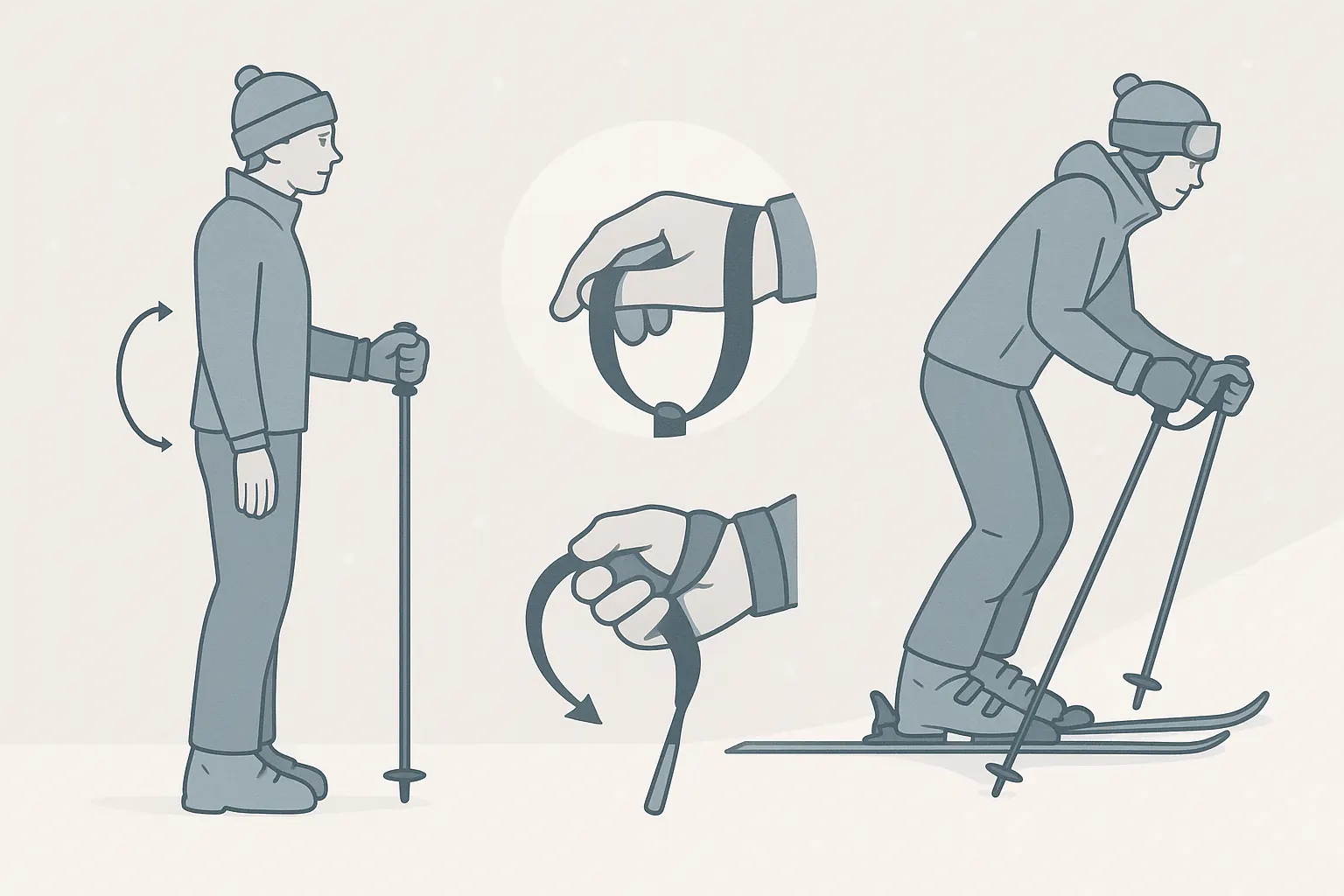
Wear ski boots, hold the pole upside down (grip on floor, hand below the basket). Keep elbow close to body, target elbow angle ~90°.
-
Thread and tension the strap
Hand goes up through the loop, then grabs the grip over the strap. Tension so the wrist stays neutral while the strap carries part of the load.
-
Quick on-snow check
On a gentle slope, try light plants near the boot toe. If the pole pushes you back it’s too long; if it dives forward it’s too short. Adjust 0.5–1 cm as needed.
-
Fine-tune for terrain and style
For steeper, tighter rhythm, go slightly shorter; for faster, longer arcs, a touch longer. With telescopic poles, mark two positions.
Typical mistakes
- Too long – shoulders rise, you get pushed back.
- Too short – plants dive and break the timing.
- Strap entered from above – overloads hand and fingers.
- Overtight strap – stiff wrist, poor rebound.
Beginner questions
Should I measure without boots?
No. Always wear ski boots – boot height changes elbow angle.
Is there a quick height × factor formula?
Tables can mislead. Verify ~90° first, then confirm on snow and fine-tune.
Telescopic vs fixed?
Telescopic allows quick adjustments (great for touring); fixed is lighter and simpler.
Instructor’s tip
“Start with 90° at the elbow, then do three light plants on a mellow slope. If it pushes you back, shorten; if it dives, lengthen slightly.”
Conclusion
Well-adjusted poles make rhythm effortless and turns more stable. A quick check before first run pays off all day.