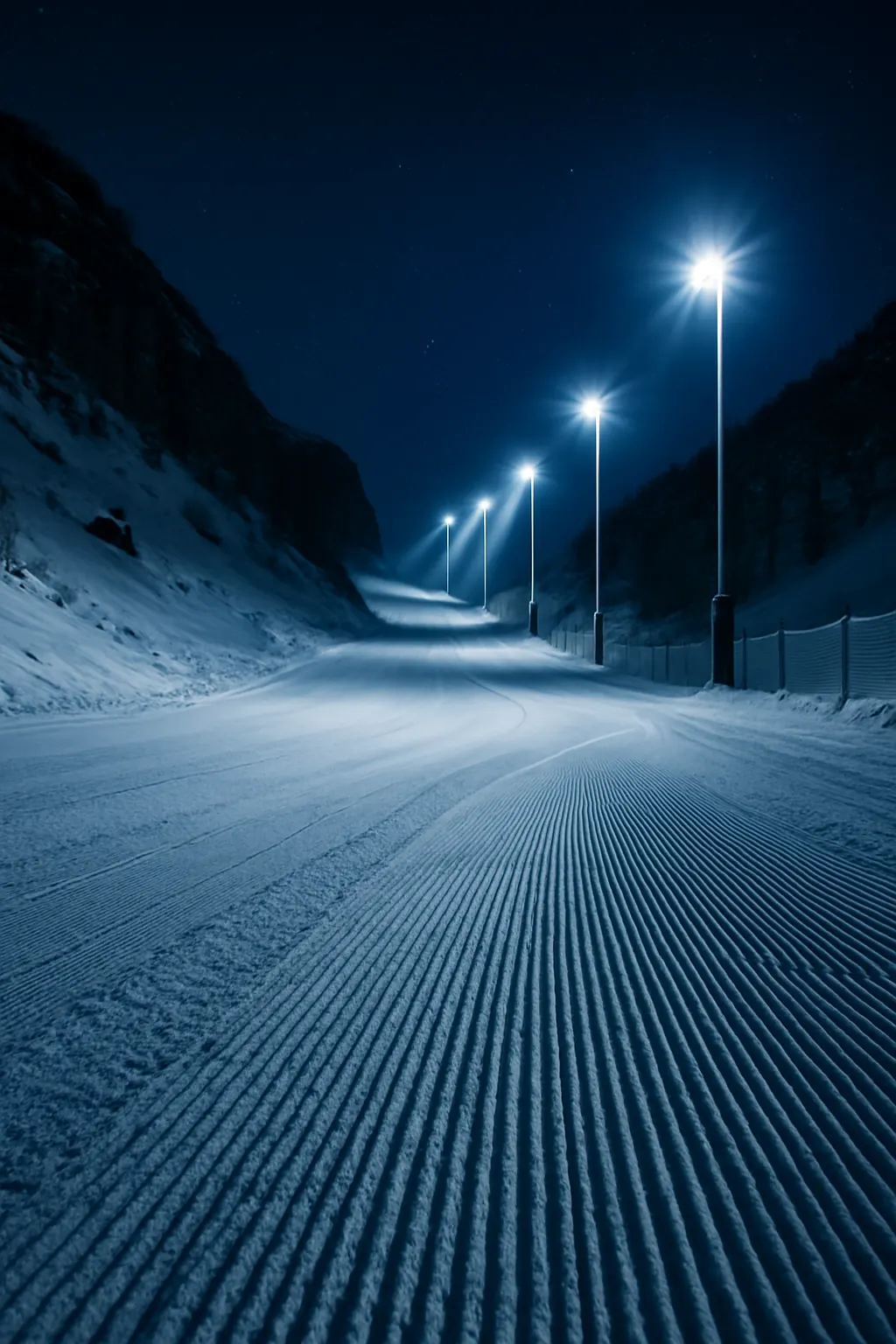
Short story: from idea to bright corduroy
Night skiing has been around for decades, but LED floodlights made it truly efficient. The goal is simple: enough light where it’s needed (the piste), how it’s needed (uniform), with minimal power draw and glare.
How slopes are illuminated
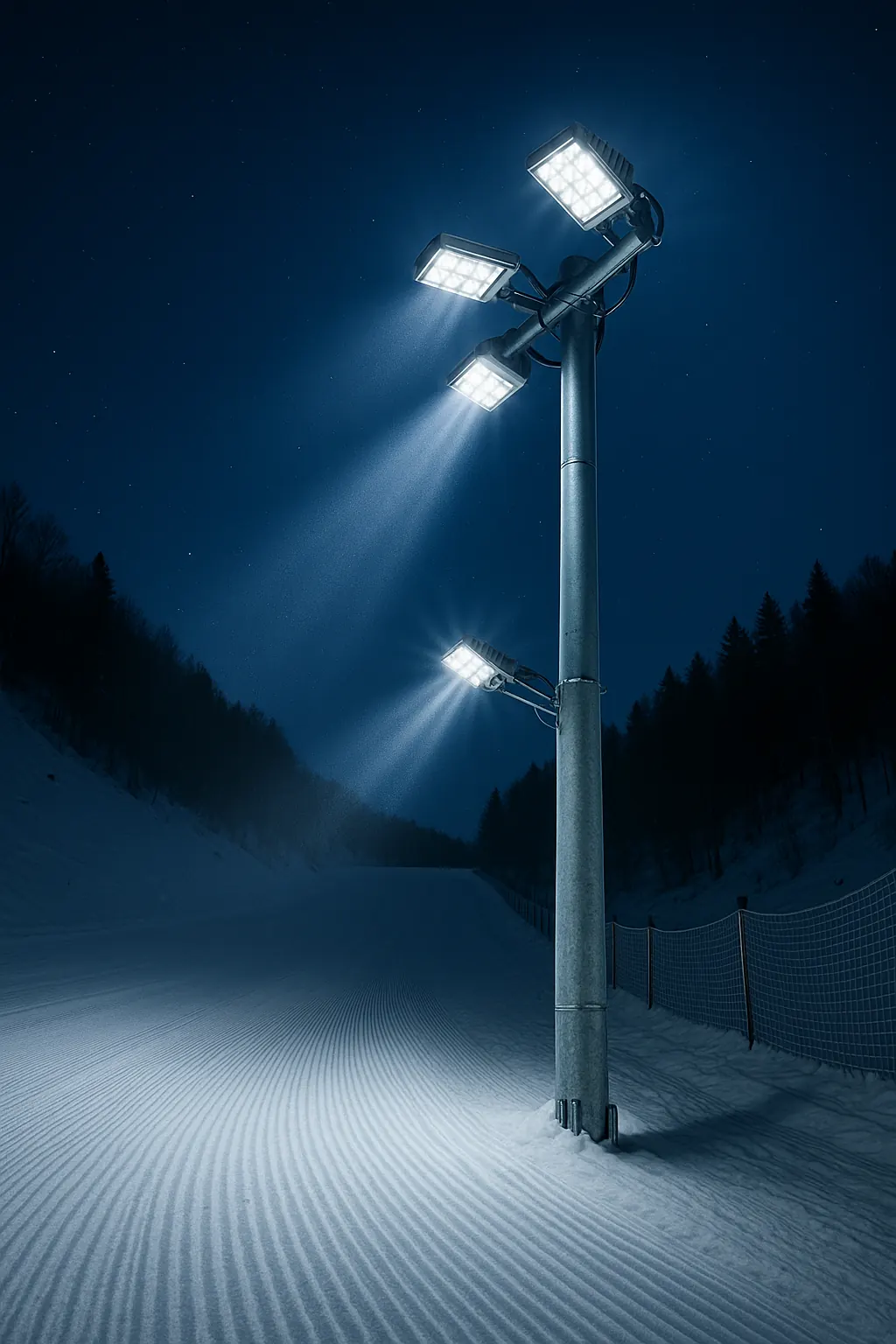
Fixtures run along the line of the slope: poles alternating left/right or on both sides, with higher intensity on curves and steeper sections. Key metrics are illuminance and uniformity—avoiding patchy pools of light and deep shadows.
Technologies: LEDs, optics, control
- LED floodlights: high efficacy (lm/W), instant start, long life, low maintenance.
- Optics & beam angles: narrow for throw, wide for piste width; anti-glare shields.
- Color temperature: typically 4000–5700 K for good contrast on snow.
- Smart control: zoned dimming, time profiles, wind/fog sensors.
- Safety & standards: uniformity and glare control for groomer drivers and skiers.
Design: how much light is “enough”?
Recreational night pistes target stable, even lighting (no harsh contrasts). Race courses demand more light and tighter uniformity due to higher speeds and TV coverage. In practice, more modest beams often beat a few “super-bright” ones— eyes fatigue less and terrain is easier to read.
What does it cost? (ballpark)
CAPEX (installation): poles, foundations, cabling, distribution, fixtures, cabinets, design and measurements. OPEX (operation): electricity (kWh), periodic service, parts replacement, inspections.
Illustrative calculation (1 km piste):
- 30 poles × average 2 × 600 W LED fixtures = ~36 kW installed power
- Operating 4 h/night → ~144 kWh/night
- At an energy price of X €/kWh → ~144 × X € per night (excluding other costs)
Note: real figures depend on piste width/steepness, snow/air conditions, required uniformity, and local energy prices.
Ecology and neighbors: light pollution
Good design limits spill outside the piste: lower poles where feasible, aimed optics, shields, and careful aiming. That preserves the night landscape and wildlife—and keeps the valley neighbors happier.
Conclusion
Night skiing blends technology with economics: good optics and smart control deliver safe, even lighting with reasonable consumption. When properly designed and maintained, the night turns the piste into a fresh shift of fun.