Short story: physics under your bindings
When the morning dips below about −10 °C, each step on snow answers with a dry 'squeak'. An hour later the same slope can feel faster— simply because the temperature nudged upward. It all comes down to crystals, moisture and a thin water film created by friction.
Why does snow 'squeak'?
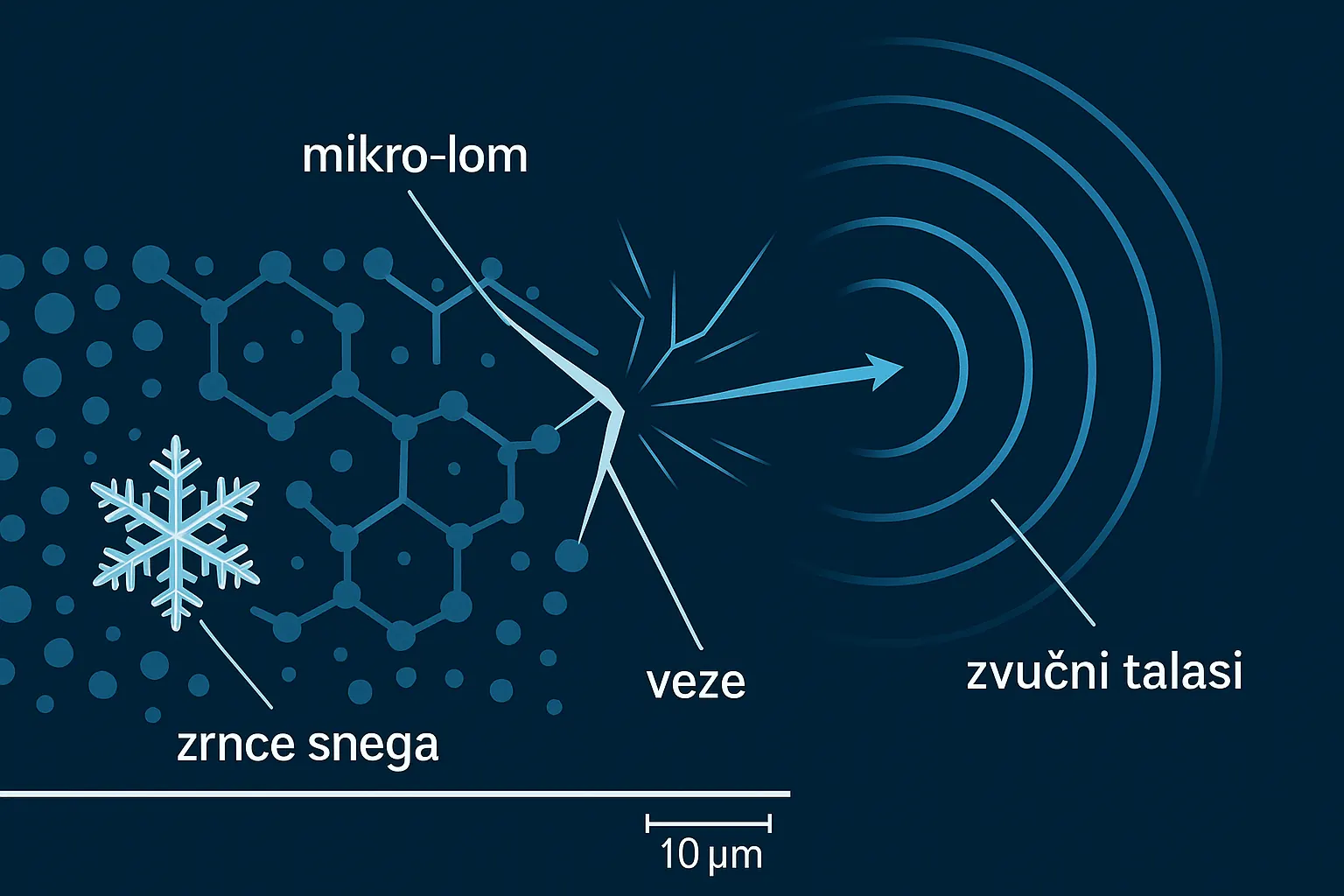
At very low temperatures (often below about −10 °C), flakes and grains are dry and brittle. Under the pressure of a boot or ski, micro-fractures in the crystals release short, high-pitched sounds—that's the characteristic 'squeak'. As snow warms and moistens, crystals round off and the sound fades.
Friction and speed: dry vs. wet
- Very cold, dry snow (≈ ≤ −10 °C): dry crystal–base contact dominates; no water → higher friction, slower.
- Slightly cold snow (≈ −6 °C to −2 °C): friction creates a micro water film; glide speeds up—often the 'fastest' window.
- Warm snow (≈ −1 °C to 0 °C and above): too much free water → capillary suction and hydrodynamic drag—slower unless structure/wax match the conditions.
Peak speed happens when there's just enough water to lubricate, but not enough to 'suck' the ski down. That's why early-morning corduroy a few degrees below zero often feels like a highway.
Crystals, metamorphism and machine-made snow
Snow reshapes with temperature and humidity: sharp flakes round off (metamorphism) and grains pack tighter. Machine-made snow is denser and more granular, with more contact points—often 'slower' unless the base/structure is tuned for it.
Base structure and wax: channels and hardness
Base structure (stone grind) creates micro-grooves that evacuate water. For cold, dry snow choose a finer pattern; for warm, wetter snow use a more open, coarser one. Wax: in very cold snow favor harder waxes (reduced abrasion and static stick); in warmer conditions go softer with strong hydrophobics (now commonly fluoro-free).
Snow Types & Typical Behavior
A quick tour of common textures — and what to expect under your skis.
- Corduroy (−6 °C to −2 °C): often the fastest window of the day.
- Powder: float and control, but slower on flats.
- Hardpack / ice: low drag, but demands sharp edges and solid bite.
- Wet / slushy snow: more water ⇒ more drag without proper structure and warm wax.
When is snow fastest?
Most often in slightly cold conditions (roughly −6 °C to −2 °C) on freshly groomed pistes, when friction creates a thin, stable water film. In deep sub-zero 'squeaky' cold it's slower due to dry friction; around freezing, excess water causes suction. Tune structure and wax—and the same day can 'unlock'.
Conclusion
The 'squeak' is crystal fracture; speed is the balance between dry and wet friction. Read temperature, texture and moisture, set up your base and wax—and turn snow physics into an on-slope advantage.